
Well, Blogspot, it's been eighteen and a half months. You've been good to me, but now I'm moving on.
This blog is no longer active. All updates are now to be found on my new website, Skeptophile.com. The blog has been reincarnated there, under the same name. So update your bookmarks:
http://skeptophile.com/blog is the new address for A Sceptical I.
See you on the other side!
Saturday, 1 August 2009
Farewell...


Wednesday, 29 July 2009
Rumblings...
For various reasons, I've decided that the time has come to move my personal website from a friend's server, where it has been sat happily for a good number of years, to a more .. official .. position. To this end, I have purchased a domain name and begun renting the old web hosting thingy.
I'm still deciding what the new site should involve, as I want more than just the basics I had on the old one. For starters, I intend to move this blog to the new address; but I also want the wider site to be about the general theme of this blog - science meets the humanities, finds they can get along, and all that.
I'll keep you updated here, of course, at least until the new site is up and running and can get by on its own without stabilisers. Any suggestions you have for the new site will be gratefully received, of course.
Saturday, 25 July 2009
Mythology
If you know me (whether personally or simply through my posts here), you'll probably know I have a fascination with mythology. This extends beyond a mere enjoyment of the stories, into what they can tell us about the human condition, and our cultural history. But recently, I heard a wonderful quote which I'd like to share with you, as best as I can remember it:
"Mythology is a vital part of our history, and must be kept alive. But to claim that one mythology is more valid, or holds more truth than another, is arrogant and dangerous. (pause) Basically what I'm saying is that religion is bullshit."
 An elegant summary if ever there was one. The speaker in this case was a man I'm coming to admire more and more - Heri Joensen, vocalist of the very excellent Faeroese folk metal band Tyr. They've always had strong pagan overtones in their music, and he is becoming less subtle and more outspoken about his distaste for religion - particularly Christianity purely due to the history of persecution in Northern Europe around the turn of the second millennium.
Thinking about this recently, I recalled a teacher I had at A-Level, in Religious Studies. A creationist (and a bloody nice bloke by the way), he objected to the term "Christian mythology", because he felt it somehow denigrated the religion. I disagreed silently at the time, unsure of my ability to marshal arguments against his position. But on reflection now, it's not a difficult case to demolish. The real question is, why on earth would Christianity not count as mythology? Perhaps on first glance it's a little more subtle (or perhaps dull and boring would be a more honest appraisal) than most mythologies, with highlights being a rather tame collection of stories that would seem unremarkable indeed amongst the vibrant madness that one encounters in those of Egypt, Greece, India, and Scandinavia (to name but a few). But a lack of imagination does not exempt it from being mythological.
It is still, after all, a collection of stories, with symbolism and morals and magic and impossible events. There is no objective reason to place it above any other set of mythologies, and of course the impulse to do so comes simply for one's own biased regard for that one belief system. Which is why I think it is sad (however inevitable it may be) when one set of mythologies manages to all but wipe out a competing one, and I think that Christianity's triumph in Europe is one of the great cultural tragedies of history. But why did it succeed? Why did people choose to follow the teachings of the Bible over their own cultural stories?
Well of course, to get the answer to that question we need to look predominantly to the ruling class; it was they who converted first, and passed on that conversion to their people, through force, persuasion, or simply a kind of peer pressure. So the question becomes one of why those in power adopted the new faith from the south. Was it a resonance of truth and goodness they felt? Possibly, I'll not deny that. But looking at it realistically, I'd say it was more likely that the majority of them simply found it more useful, more expedient.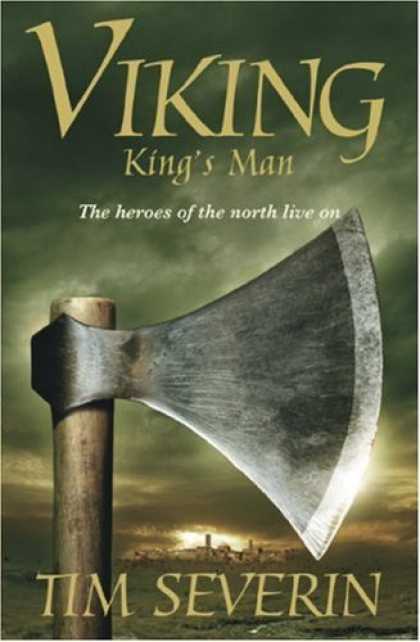 I don't think it is too controversial to suggest that most of those in power are there because they sought it. It is hardly a leap to also suggest that those who seek power and attain it do not cease to seek it. Is it any wonder that they chose to adopt a religion which preaches meekness, obedience, unquestioning devotion, and enforces it with fear? I'm afraid I have another quote for you, this time from a novel I read fairly recently. It's Viking: King's Man, book three of a wonderful trilogy by Tim Severin:
"...the worship of the White Christ suits men who seek to dominate others. It is not the belief of the humble, but of despots and tyrants. When a man claims he is specially selected by the White Christ, then all those who follow that religion must treat him as if they are revering the God himself... This is a contradiction of all that the God is meant to stand for, yet I have witnessed how, among rulers of men, it is the truly ruthless and the ambitious who adopt the Christian faith, then use it to suppress the dignity of their fellows."
Simply, Christianity succeeded where other mythologies failed because it was a useful tool by which men might gain and maintain power. Politics has, once again, shown itself to be a (if not the) driving force behind major cultural change. However innocent, bland and otherwise fluffy and inoffensive* a belief system might be, there will always be someone there to exploit it. That's human nature.
* Though I might note here that, despite the commendable and generally positive attitude of many of its adherents, Christianity isn't the nicest of religions once you examine the literature. No, sir.
Wednesday, 22 July 2009
Provoked thoughts
Last night I went to see a talk by the great Richard Wiseman at Leicester Skeptics in the Pub. A most entertaining and interesting evening was had by all (if my own experience and that of my friends was representative). When we got home, we had a look at some of the things Richard has on his blog, and came across this video:
Of course we partook of the rather bizarre-looking ritual and by the end there was a great deal of space between my hands, while my partner's had barely moved. This is of only passing interest, really. The really thought-provoking part came later when I considered this in relation to the next talk taking place in Leicester.
On the 18th of AUgust, Dr Christine Mohr is giving a talk about the links between imagination / creativity and belief in the paranormal. Perhaps it's not immediately apparent where this is going, but bear with me.
The personality test from Richard Wiseman is (unless I am somewhat mistaken) an example of the ideomotor effect. It is not a stretch to suggest (indeed Richard does so himself, I think) a connection between this effect and greater imagination. Is there, then, a case to be made for a related connection between the ideomotor effect and belief in the paranormal?
I'd hardly be surprised if there were, but it just struck me as one of those neat little webs of interrelated causes and effects that make science (and fringe science, like psychology) so very interesting.
On a partly-related note, you might be interested to learn that movements are being made in the direction of establishing a Skeptics in the Pub event in Birmingham. Seeing as this is so close to my current residence, I'm trying to get involved in helping set it up. Hopefully I will have some solid news to report on this front soon, or at least a tentative update.
Wednesday, 15 July 2009
The Power of the Hypothetical
 "So remember, when you're feeling very small and insecure,
How amazingly unlikely is your birth..."
In science, an hypothesis is a wonderful thing. It is the glimmer of imagination and possibility that can give rise to years of research and fascinating advances in our knowledge of the world. But it is still just the preliminary stage - when people say something is "just a theory", they are thinking of the colloquial meaning which is more analogous to hypothesis. It's a weak form of knowledge, little better than conjecture.
But the power of the hypothetical goes beyond that. In philosophy, hypothetical scenarios are often (or indeed exhaustively) used to examine arguments, beliefs, and assumptions - of which the subject is sometimes previously unaware of using / having / making. I'm currently leafing through a book full of such hypotheticals - called The Pig That Wants To Be Eaten. The title is perfectly demonstrative of the kind of thinking contained therein - thought experiments which are often semi-nonsensical, but which nevertheless challenge us to examine our underlying reasons for what we believe. IS it immoral to eat a pig that wants to be eaten (assuming it is immoral to eat one that does not)? And if so, why? This is one of the reasons I so enjoy science fiction - there is such an immense crossover with so many areas of philosophy, and there is no better arena for bringing thought experiments and hypotheticals into the mainstream consciousness. Just look at The Matrix - how many people had questioned the very nature of reality, and the evidence of their senses, before watching that film? Every philosopher was familiar with the idea, of course - as it was an imaginative adaptation of Descartes' hyperbolic doubt and evil demon hypothetical. But it wasn't well-known, in the public sense of the phrase.
Now it seems the hypothetical has been given yet more power - or rather, yet another facet of its power has been discovered. Previous to this recent research, people were often encouraged to promote a positive outlook in themselves by focusing on the good things in their lives, "counting their blessings", as it were. However, studies into this method returned mixed results at best, and a new hypothesis was tested - that, rather than simply thinking about the positive aspects of one's life, one should imagine what one's life would be like had those things never happened at all. The contrast this creates between the present and the parallel (and negative) "possible presents" reinforces the positivity of one's life.
So next time, instead of just thinking "it could be worse", perhaps you should actually think about exactly how it could be worse. And how easily it might have turned out that way.
Koo, M., Algoe, S., Wilson, T., & Gilbert, D. (2008). It's a wonderful life: Mentally subtracting positive events improves people's affective states, contrary to their affective forecasts. Journal of Personality and Social Psychology, 95 (5), 1217-1224 DOI: 10.1037/a0013316
Thursday, 11 June 2009
Breaking my silence to support free speech
It's no surprise to those who read this blog that I'm kind of in favour of free speech - you know, just a bit. It's one of the many reasons I've taken an interest in the ongoing legal battle between Simon Singh and the British Chiropractic Association. It's also why I'm here to promote the Sense About Science campaign to keep libel laws out of science. I've added the badge to the side bar and I recommend you click on it. If you're just too damn lazy to scroll down (and who could blame you?) here it is:
And with that, I leave you again. I apologise for my long silences of late, but we still have no internet access in the flat and with my new job I have a lot less free time than I used to when I was unemployed. Hopefully the former situation will resolve soon, and I'll be back with you, boring your eyes out as usual.
All the best, dear hypothetical reader. Until next time.
Friday, 8 May 2009
BCA vs Singh update
On the offchance any of my readers do not also read the great bloggings of my friend Jack of Kent, I recommend that you take a gander at his new update on the preliminary hearing of the libel case brought against Simon Singh by the British Chiropractic Association (to be found here).
I have nothing to add, except in echoing Jack's sentiment that this is an astonishing, bizarre and horrendously illiberal ruling.
Wednesday, 6 May 2009
Two apologies, and a follow-up
The first apology is for the past month - not only has it been a hectic and internetless move to the new flat, but calamity and illness have also meant that I've been far from being in the right frame of mind to write here. The second apology is for the future, because I don't know how often I'm going to be able to post over the next month or two. The internet connection is hardly forthcoming, and the precious hours I'm able to squeeze out of the wi-fi access at the pub are being consumed simply by trying to stay up-to-date and in contact with my friends. So, I apologise.
You might be interested to know that there have been a great many reasons to believe that the rune casting I made a month ago has proven to be true - certainly the move was made, and I even went down to Southampton for a very brief visit to bring more of my belongings up to the flat. This would definitely justify the presence of the "Raido" journeying rune. The "Algiz" sanctuary rune is similarly easy to explain through the new flat, as it is definitely starting to feel like a home and safe haven. The reversed "Dagaz" night rune, which apparently can serve as a warning of plans going awry, can also be seen to have come true. Let's just say the move has not been without problems.
So a clean sweep with my first cast. Not bad going. It's definitely illustrating for me how people can easily believe in the power of these things, particularly when the interpretation is so vague and malleable.
I hope I'll be able to post a little more often now that things are starting to straighten out at home. I'll definitely be back when the internet manages to make its glittering and wondrous way into our abode. Perhaps the next entry will be another rune casting. Whenever and whatever that next post is, I'll see you then.
Friday, 3 April 2009
Premonitions
Today's entry is about the future.
Firstly, because I need to warn you that the blog might be a little quiet over the next few weeks as I move to a new flat with the very special feature of Uncertain Internets. Got a few ideas in the pipeline, though, so hopefully I'll be able to get online enough to keep this blog up and running.
Secondly, it strikes me that this is an ideal time to introduce a new regular feature here, tying into my status as a pagan atheist. You may or may not know that the Northern European mythologies, with which I most closely relate, contain a system of auguries involving runes. These work in much the same way as the more popular tarot cards, with a number of symbols standing for various ideas. What I thought I'd do is something of an experiment, in no way scientific, into the practice of using these runes to read my "fortune". After setting up the rules (the method of taking a reading, the meanings of each rune, and any restrictions on interpretation), I'll try to take regular-ish readings and then see how true they turn out to be. So, on with it.
Right from the outset, let me make this clear: this is not a test of the ability of rune-casting to predict the future or disclose facts about the past. The sole purpose of this little exercise is basically to just get an insight into how these readings can be interpreted to fit a normal life with normal events, without the intervention of a cold reader or medium.
My method will be simple: when making a cast, I will shake all the runes in my cupped hands, and carefully let three fall at random, without seeing which they are. Those will be my reading, and the rest put aside for the time being. If a rune lands facing up, its standard meaning will hold sway; if it is face down, I will interpret that as a reversed meaning - for instance, if Eihwaz lands facing up, it means safety; if facing down, it means danger or vulnerability.
Here's a basic list of the runes and their primary meanings. Fehu: wealth. Uraz: strength. Thurisaz: chaos. Ansuz: wisdom. Raido: journey. Kaunaz: fire. Gebo: gift. Wunjo: joy. Hagalaz: disruption. Nauthiz: need. Isa: standstill. Jera: success. Eihwaz: safety. Pertho: future. Algiz: sanctuary. Sowulo: sun. Teiwaz: victory. Berkana: life. Ehwaz: horse. Mannaz: man. Laguz: water. Inguz: fertility. Othila: inheritance. Dagaz: day. Blank: destiny.
So right away we see that runes are representative of some very vague and open-to-interpretation notions. Virtually any reading could probably be twisted to fit the complexities of a normal life. But let's not allow that to dissuade us! This should be fun. So here's the first cast:
Raido. Algiz. A reversed Dagaz.
So a journey, sanctuary, and something that probably represents night. I'd call that a pretty great hit for a first cast - we're moving (or "journeying") to a new flat (or "sanctuary") after all. Not sure what the night part represents, though. I'm led to understand that "day" carries along with it implications of certainty and optimism - as in, daylight is the time to get things done. Is it telling me that this is not the right time for a journey to our new sanctuary? Or is it reflecting our feelings of insecurity about the enterprise? Or perhaps it's referring the the lack of security in my partner's job right now. Hmmmm.
Well this might turn into a regular feature, it might not. Either way, it's always interesting to think about why these methods of prediction and fate-reading are so popular, and why they seem to work so well a lot of the time. As I said, I'm not going to change my mind on this - I don't believe that the rocks I drop with scratches in can tell me what's going to happen next week. It's just something I'm using to gain and share some insight into the interpretation process. I hope you enjoy and value it as much as I do.
Subscribe to:
Posts (Atom)


