
If you know me (whether personally or simply through my posts here), you'll probably know I have a fascination with mythology. This extends beyond a mere enjoyment of the stories, into what they can tell us about the human condition, and our cultural history. But recently, I heard a wonderful quote which I'd like to share with you, as best as I can remember it:
"Mythology is a vital part of our history, and must be kept alive. But to claim that one mythology is more valid, or holds more truth than another, is arrogant and dangerous. (pause) Basically what I'm saying is that religion is bullshit."
 An elegant summary if ever there was one. The speaker in this case was a man I'm coming to admire more and more - Heri Joensen, vocalist of the very excellent Faeroese folk metal band Tyr. They've always had strong pagan overtones in their music, and he is becoming less subtle and more outspoken about his distaste for religion - particularly Christianity purely due to the history of persecution in Northern Europe around the turn of the second millennium.
Thinking about this recently, I recalled a teacher I had at A-Level, in Religious Studies. A creationist (and a bloody nice bloke by the way), he objected to the term "Christian mythology", because he felt it somehow denigrated the religion. I disagreed silently at the time, unsure of my ability to marshal arguments against his position. But on reflection now, it's not a difficult case to demolish. The real question is, why on earth would Christianity not count as mythology? Perhaps on first glance it's a little more subtle (or perhaps dull and boring would be a more honest appraisal) than most mythologies, with highlights being a rather tame collection of stories that would seem unremarkable indeed amongst the vibrant madness that one encounters in those of Egypt, Greece, India, and Scandinavia (to name but a few). But a lack of imagination does not exempt it from being mythological.
It is still, after all, a collection of stories, with symbolism and morals and magic and impossible events. There is no objective reason to place it above any other set of mythologies, and of course the impulse to do so comes simply for one's own biased regard for that one belief system. Which is why I think it is sad (however inevitable it may be) when one set of mythologies manages to all but wipe out a competing one, and I think that Christianity's triumph in Europe is one of the great cultural tragedies of history. But why did it succeed? Why did people choose to follow the teachings of the Bible over their own cultural stories?
Well of course, to get the answer to that question we need to look predominantly to the ruling class; it was they who converted first, and passed on that conversion to their people, through force, persuasion, or simply a kind of peer pressure. So the question becomes one of why those in power adopted the new faith from the south. Was it a resonance of truth and goodness they felt? Possibly, I'll not deny that. But looking at it realistically, I'd say it was more likely that the majority of them simply found it more useful, more expedient.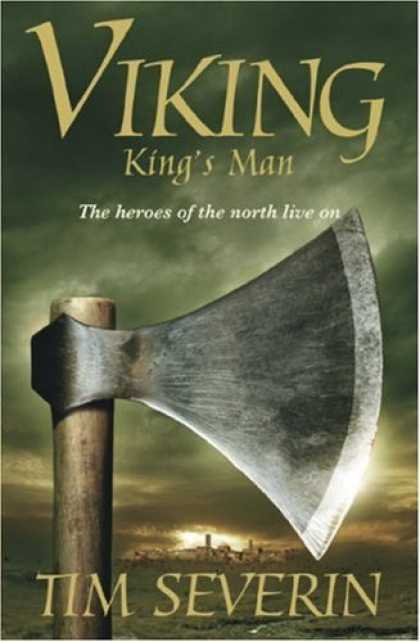 I don't think it is too controversial to suggest that most of those in power are there because they sought it. It is hardly a leap to also suggest that those who seek power and attain it do not cease to seek it. Is it any wonder that they chose to adopt a religion which preaches meekness, obedience, unquestioning devotion, and enforces it with fear? I'm afraid I have another quote for you, this time from a novel I read fairly recently. It's Viking: King's Man, book three of a wonderful trilogy by Tim Severin:
"...the worship of the White Christ suits men who seek to dominate others. It is not the belief of the humble, but of despots and tyrants. When a man claims he is specially selected by the White Christ, then all those who follow that religion must treat him as if they are revering the God himself... This is a contradiction of all that the God is meant to stand for, yet I have witnessed how, among rulers of men, it is the truly ruthless and the ambitious who adopt the Christian faith, then use it to suppress the dignity of their fellows."
Simply, Christianity succeeded where other mythologies failed because it was a useful tool by which men might gain and maintain power. Politics has, once again, shown itself to be a (if not the) driving force behind major cultural change. However innocent, bland and otherwise fluffy and inoffensive* a belief system might be, there will always be someone there to exploit it. That's human nature.
* Though I might note here that, despite the commendable and generally positive attitude of many of its adherents, Christianity isn't the nicest of religions once you examine the literature. No, sir.


 The particular example I want to use today, however, is a little more complex. Those of you who read my footnote on the post-Roddenberry Star Trek in my previous post will know that I noted a drop in secular humanism as a theme after Gene Roddenberry's departure. What I'd like to add to that is that subsequent series did seem to be more morally complex than TOS and TNG, and, while they were more accommodating to religion, they rarely - if ever - attributed to it powers that it does not and could not possess.
 But when a religious controversy springs up about the


 I have a lot of time for Andrew Marr; I think as a historian and particularly as a presenter of history, he has a great deal to offer. But in this case, he is either ignorant of the facts, or simply creating a controversy for the sake of having something to say on the matter. Because what does his article actually argue?

 In this, the first part, I want to focus on the secular humanism that can be seen in virtually every episode of both the original series (TOS) and the Next Generation (TNG). As noted in
 What is also worth remembering is the radically progressive nature of TOS when it first aired. Not only were men and women portrayed working side by side as equals, but people of different races also. In fact, a previous draft of the proposal to the network for the show had Majel Barrett (later Roddenberry's wife) in the role of second-in-command. While this was more radical than the network could accept at the time, the version that finally aired was certainly still very progressive for its time.


 My mother, much like myself, loves to read books. Recently she mentioned she was reading something called
 Rather than focusing on a specific character this time, I feel the scepticism inherent in the show is better seen on the level of concepts, outlook and methodology. There are reams of material suitable for examination here, but as I've been working my way through the DVDs of series 2 I expect most of my references will be from there.
 There are a few moments in the show which could not be more perfectly symbolic of the scepticism I'm describing. One of these is in the episode
 It's hard to know where to begin with House; there is so much about him that simply screams "sceptic". He is a champion of deductive reasoning and the scientific method, a great critic of religion and anything remotely false or non-evidence based. Perhaps, as with my
 The kid's first trick is claiming that God had spoken to him of a female physician harbouring vengeful thoughts about a co-worker. This is true of Doctor Cameron, and both she and Doctor Foreman (the co-worker in question) are somewhat impressed by this. House is not, as he could see for himself the body language the boy had picked up on. It's a classic trick of psychics and the like, and though a useful thing to bring attention to it's hardly difficult to debunk.
 The big mystery, however, is the "miracle" that takes place in this episode. Boyd was wandering the halls in a daze after a complex partial seizure, and came across Grace. He told her not to worry, and asked God to make her whole again. Nothing much is thought of this, until Wilson scans her liver and finds that the tumour is shrinking. The team gets to work trying to diagnose some medical reason for this, but get nowhere.
 This is not to say that House is the perfect sceptic, of course - a man with so many problems is hardly a candidate for being the perfect anything. While he always makes diagnoses based on the evidence available, he is reckless and will often skip over further testing and move straight onto treatment - or trust his instincts rather more than a doctor probably should. He will also make assumptions based on his less-than-generous view of human nature; while this often works in his favour, it does sometimes obstruct the diagnosis process.
 I can understand and agree with almost every argument in favour of the subject - excepting the evangelical "convert the heathens" viewpoint of course - but still fail to see why it should be a) religious studies in particular, and b) why it should be compulsory. I can see the value in studying other cultures (naturally including religions), and yes that could be seen to be a good thing to have as compulsory. But please, let's have "cultural studies" or something; I can't help but feel that an emphasis on religion is doing nothing to shake the grip which superstitious nonsense has upon society.
 While the latter form of enquiry can lead to worthwhile places, it is rarely given the chance because of the religious bias. In order to free up the endeavour for these "big important questions", one must remove as much bias as possible. The neutral standpoint in this abstract area is epitomised by philosophy. This love of wisdom is the most pure form of inquiry - no question is off-limits, and the more abstract or the more challenging the better. Should philosophy replace religious education as compulsory in schools then? I believe so, but there is one subject that I think should trump it.


